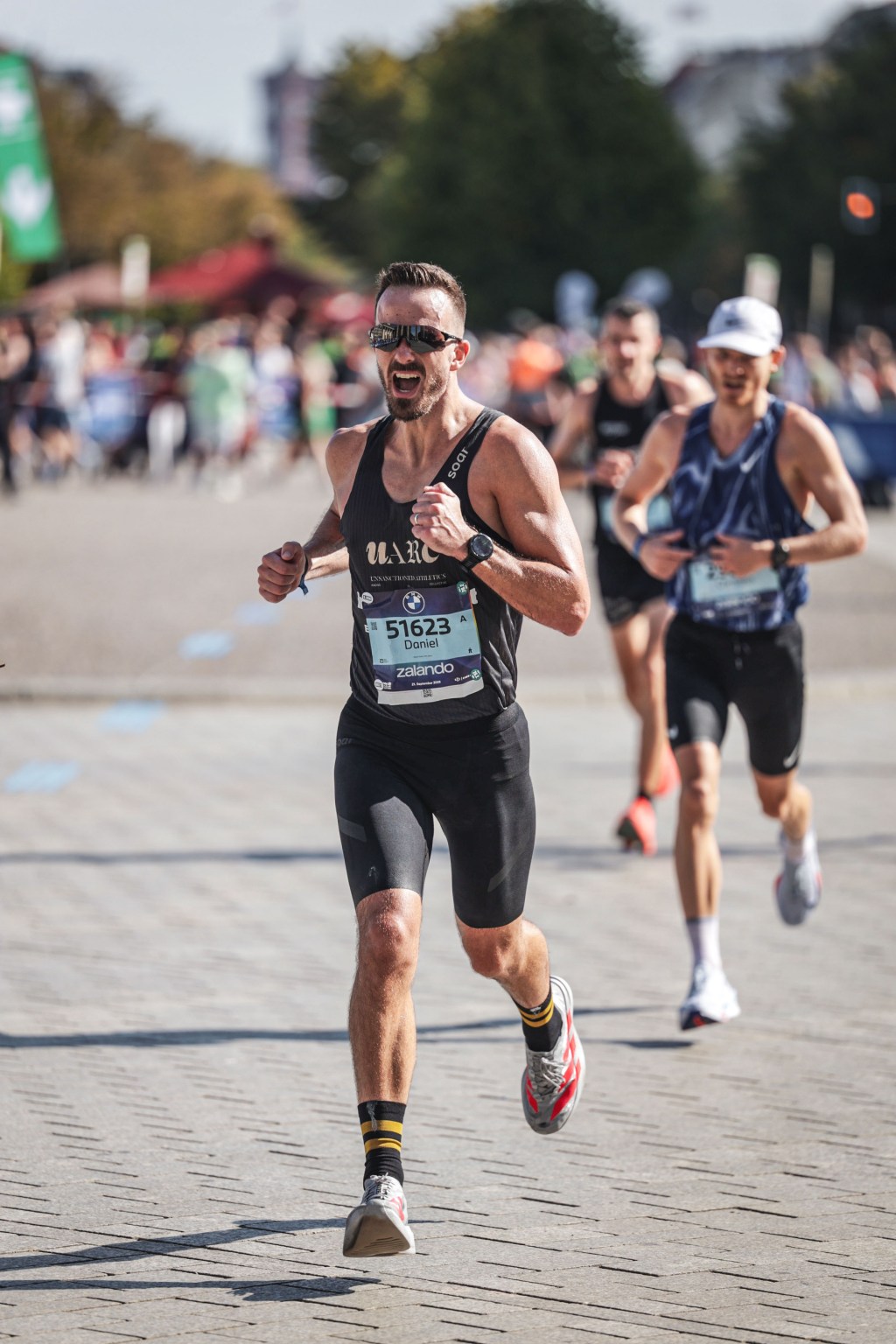
Running the Berlin Marathon on September 21st, 2025, was my third World Major and my fourteenth marathon to date. It was one of the most eye-opening experiences of my running journey so far.
Preparing for this race across the summer in Dubai presented a challenge, but not a new one as I had already trained in the later half of the summer into Valencia last year. This meant the way my training week was set up was much improved, but still somewhat an exploratory block, mainly due to planned higher use of the treadmill for quality sessions.
I wanted this block to test me more than before. I know to progress the training needs to push me, of course, but all of the other areas in life and work also need to allow for that too.
A Global Stage
Berlin carries a reputation like few others. It is a course where world records are set, the course every marathoner has heard about. The days leading into the race were full of energy: the buzzing expo, shakeout runs passing the Brandenburg Gate, and thousands of runners from across the world converging on the city. For me and many others, standing on that start line was not just about Berlin, we were there to collect another star in the journey to running all of the Majors.
The weather forecast showed higher temperatures than ideal, but I tried to ignore it. My training block had gone too well to be derailed by the weather now. That, and the fact that about four days out from the race I had picked up a cold I just could not quite shake.
The Race
Getting to the start line was straightforward until it wasn’t. Thousands of runners wanted to be as close to the front as possible, and barriers were pushed over in attempts to secure a good position.
Even in those final moments walking to the start, you could feel the warmth in the air. It was by no means a cool race day, and I knew it would only get warmer. Carrying a little of the cold I had not fully shaken off, I felt the usual cocktail of nerves and excitement. From an emotional standpoint, I made no change to how I had planned to race. No adjustment to the pace, just the decision to stick to the targets I had worked toward all summer, knowing that something along the way could still challenge that.
Pacing felt smooth for the first 5–10km, giving me a false sense of confidence that the weather might not be too much of a factor. I saw Ellis at 7.5km and felt invincible.
I sat in with a group of about seven or eight others, ticking along steadily, but somewhere around 15–18km that group dispersed. I could feel the effort required to hold the pace climbing quickly.
I decided to keep pushing until halfway and then reassess. I knew I would see Ellis again at around 19km, which would give me a boost and time to rethink if things began to fade. But inevitably, the same effort saw the pace start to slip.
From 23km, I made the tough but honest decision: continuing to push at that level of effort would not end well. I accepted what I had already suspected from a few days earlier, the combination of the lingering cold and the heat meant I would have to run the second half slower than I had planned. Something clicked in that moment and I was at peace with it. I thought: you know what Daniel, it is either sulk or enjoy running around the closed streets of Berlin with 50,000 others.
That acceptance did not make the last 19km any easier. My ears started to block up and the temperature continued to rise. But I remember the second half of the race clearly, head up, eyes open, taking in the sights and the crowds.
Running through the Brandenburg Gate was unforgettable. I asked myself: if I had still been chasing a time, would I even have looked up to take it in?
Finishing my 14th marathon and 3rd World Major in the way I did did not disappoint me at all. I do not regret racing the way I did. Playing it safe is not in my nature as an athlete, though it is something I know I need to consider more often when I have my coaching hat on.
Five Lessons From Berlin
1. Variation keeps you engaged.
This block reminded me that training does not need to be completely repetitive to be effective. With Dubai’s summer heat limiting outdoor options, I leaned heavily on the treadmill for quality sessions and mixed up my approach more than ever before. Far from being a compromise, it actually kept me excited and motivated. Adapting to the environment, finding new ways to get the work done, and embracing variety kept the training fresh and showed me that progress comes in many forms.
2. Adapting the plan can change the race.
Berlin showed me that sticking rigidly to a pre-set plan does not always serve you on the day. The conditions were warmer than ideal, and I went out with pacing goals that did not reflect that reality. Looking back, if I had adapted earlier, eased back, adjusted fuelling, managed effort instead of chasing splits, it could have been a different type of race altogether. Sometimes the strongest choice is not to stick to the plan, but to flex with the circumstances.
3. Joy is as important as discipline.
For much of this block, I was locked in on the goal: another fast marathon, another performance benchmark. But when your focus narrows too much, it can drain energy from the other things that matter, like coaching, relationships, even just the day-to-day enjoyment of training. Berlin reminded me that while discipline is essential, it should not come at the cost of joy. Keeping perspective, sharing runs with others, and embracing the community are what give running its real value.
4. Performance demands alignment.
Running well is not just about the training plan on paper, it is an accumulation of everything around it. Sleep, recovery, stress, coaching, and daily life all feed into how you perform on the start line. In this block, there were times when the balance was not there, and it showed on race day. This marathon block reminded me that to reach your best, the rest of your life has to be aligned with the training. Without that, the lows come quicker, and the highs are harder to reach.
5. The finish line is never the end.
Crossing the Brandenburg Gate and the finish line, even on a day that was not perfect, was unforgettable. But every finish line is just another chapter, not the whole story. Each marathon is fuel for the next training block, the next challenge, and everything still to come. That is why we keep showing up.
Looking Ahead
Berlin did not give me the time I wanted, but it gave me something more valuable: perspective. Every marathon is a mirror, it shows you what is working, where the cracks are, and what you need to carry forward, and what you do not.
That is why we keep coming back.
The marathon is never just about 42.2 kilometres. It is about learning from and applying the lessons long after the race is done.
And Berlin, with all its history, crowds, and challenges, handed me some of the most important ones yet.
 Daniel Bagley | Running Coach
Leave a comment